
Why this becomes a problem
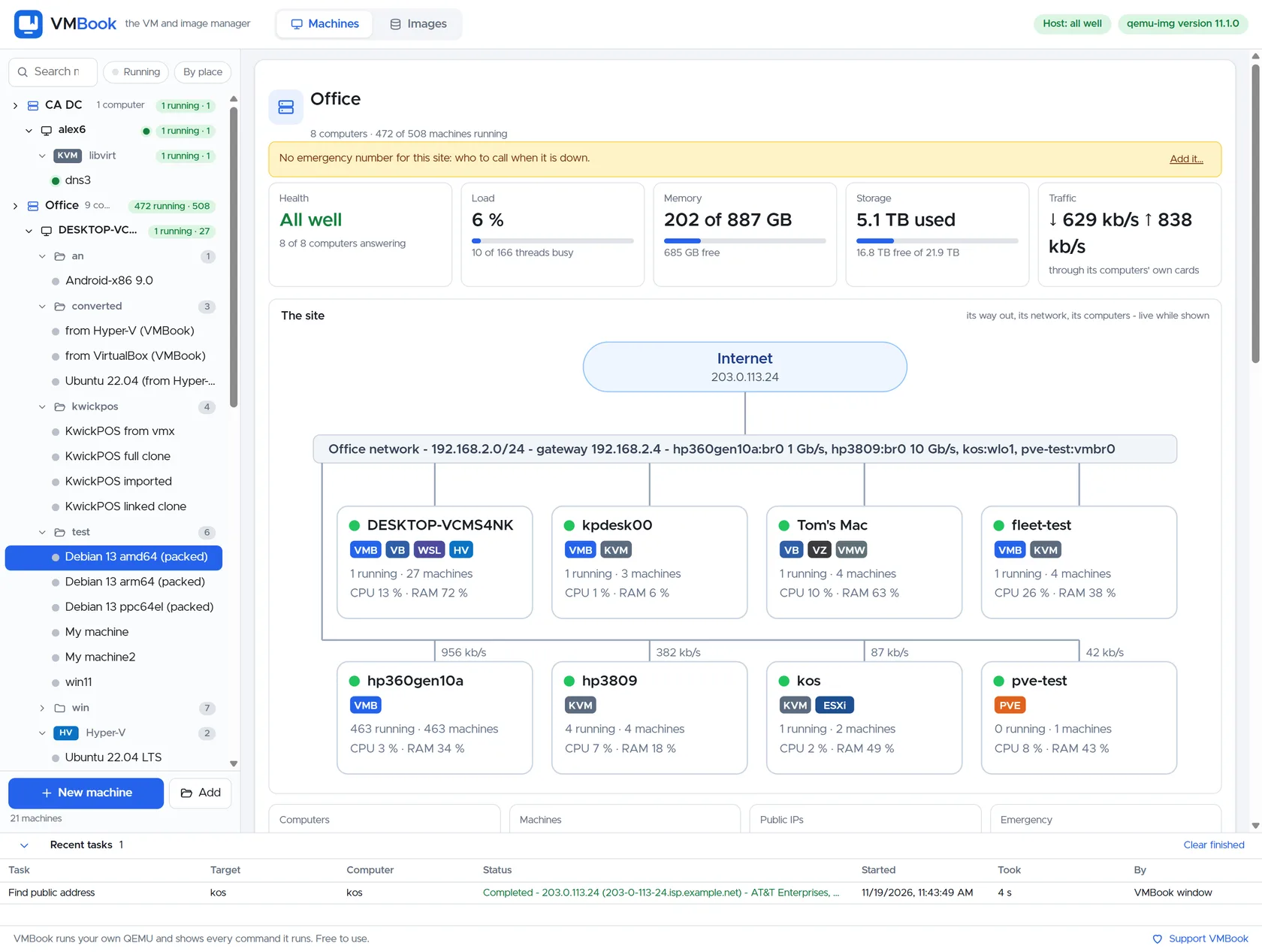
Tools designed for one hypervisor often assume one cluster or vendor. Real organizations accumulate ESXi, Proxmox, Hyper-V, KVM and desktop hosts through acquisitions, labs and local requirements. Operators then switch portals, duplicate credentials and lose the relationship between public connectivity, site health, storage capacity and the guests affected by a host outage.
How VMBook approaches it
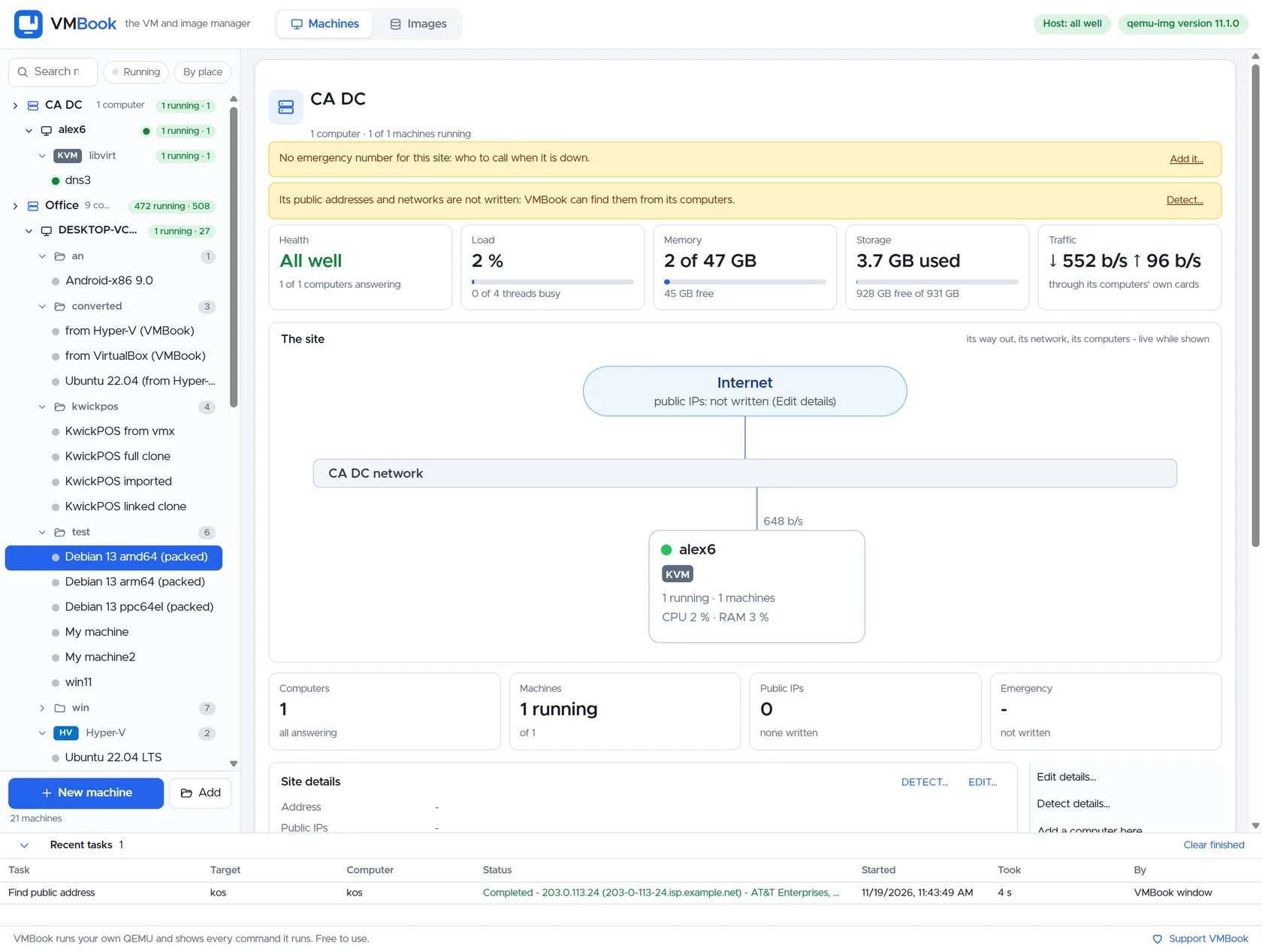
VMBook uses a site → computer → platform → machine hierarchy. A site can describe its route out, management network, computers, capacity and emergency contact while each computer remains responsible for native actions. This preserves local failure boundaries and gives an operator one operational book without pretending that unlike hypervisors have identical semantics.
Recommended workflow
- Define sites around operational ownership and failure domains, not merely geography.
- Record management routes, emergency contacts and time zones before importing machines.
- Connect one read-only or test computer per platform and reconcile names and totals.
- Separate site health from machine state so a network outage is not misreported as hundreds of guest failures.
- Stage lifecycle permissions only after inventory and monitoring are trustworthy.
- Test loss of a site connection and confirm other sites remain manageable independently.
Limits and checks
VMBook 0.1 does not claim global high availability, distributed consensus or automatic cross-site failover. A common inventory does not make storage synchronous or networks portable. Disaster recovery still requires replicated data, tested boot dependencies, documented DNS changes and people authorized at each location.
Primary documentation
- VMBook multi-site solution
- VMBook architecture documentation
- Red Hat virtualization disaster recovery concepts
Frequently asked questions
What problem does this guide solve?
A multi-data-center VM inventory should answer four questions immediately: which site, which physical computer, which virtualization platform and which machine. A flat global list is convenient for search but dangerous for operations because identical names can belong to different networks and recovery teams.
How does VMBook help?
VMBook uses a site → computer → platform → machine hierarchy. A site can describe its route out, management network, computers, capacity and emergency contact while each computer remains responsible for native actions. This preserves local failure boundaries and gives an operator one operational book without pretending that unlike hypervisors have identical semantics.
What should I verify before using it?
VMBook 0.1 does not claim global high availability, distributed consensus or automatic cross-site failover. A common inventory does not make storage synchronous or networks portable. Disaster recovery still requires replicated data, tested boot dependencies, documented DNS changes and people authorized at each location.

