
A Mac product choice
Shipping integration versus cross-platform direction: VMBook and Canonical MicroCloud.
Choose MicroCloud when a small set of Ubuntu systems should become an integrated LXD, Ceph and OVN cluster. Choose VMBook when existing mixed platforms and QEMU architecture experimentation matter more than a standardized cluster.
Use the exact Mac as the test bench
Compare the Mac experience that ships today with VMBook’s current boundary.
| Decision area | VMBook build 1.0.0 | Canonical MicroCloud |
|---|---|---|
| Starting point | One desktop or heterogeneous remote computers. | A small set of nodes forming one cluster. |
| Workloads | QEMU VMs plus delegated VM/container providers. | LXD virtual machines and system containers. |
| Data plane | No built-in distributed storage or overlay network. | MicroCeph storage and MicroOVN networking. |
| Best fit | Mixed estates and experimental architectures. | Compact standardized private cloud. |
A VMBook site is organizational; it is not a MicroCloud cluster, storage quorum or virtual network.
Export deliberately and retain the original bundle
Retain the original Mac bundle and test the export on the exact target hardware.
VMBook does not currently manage MicroCloud as a cluster or reproduce its distributed storage and networking semantics.
Small cloud versus mixed fleet
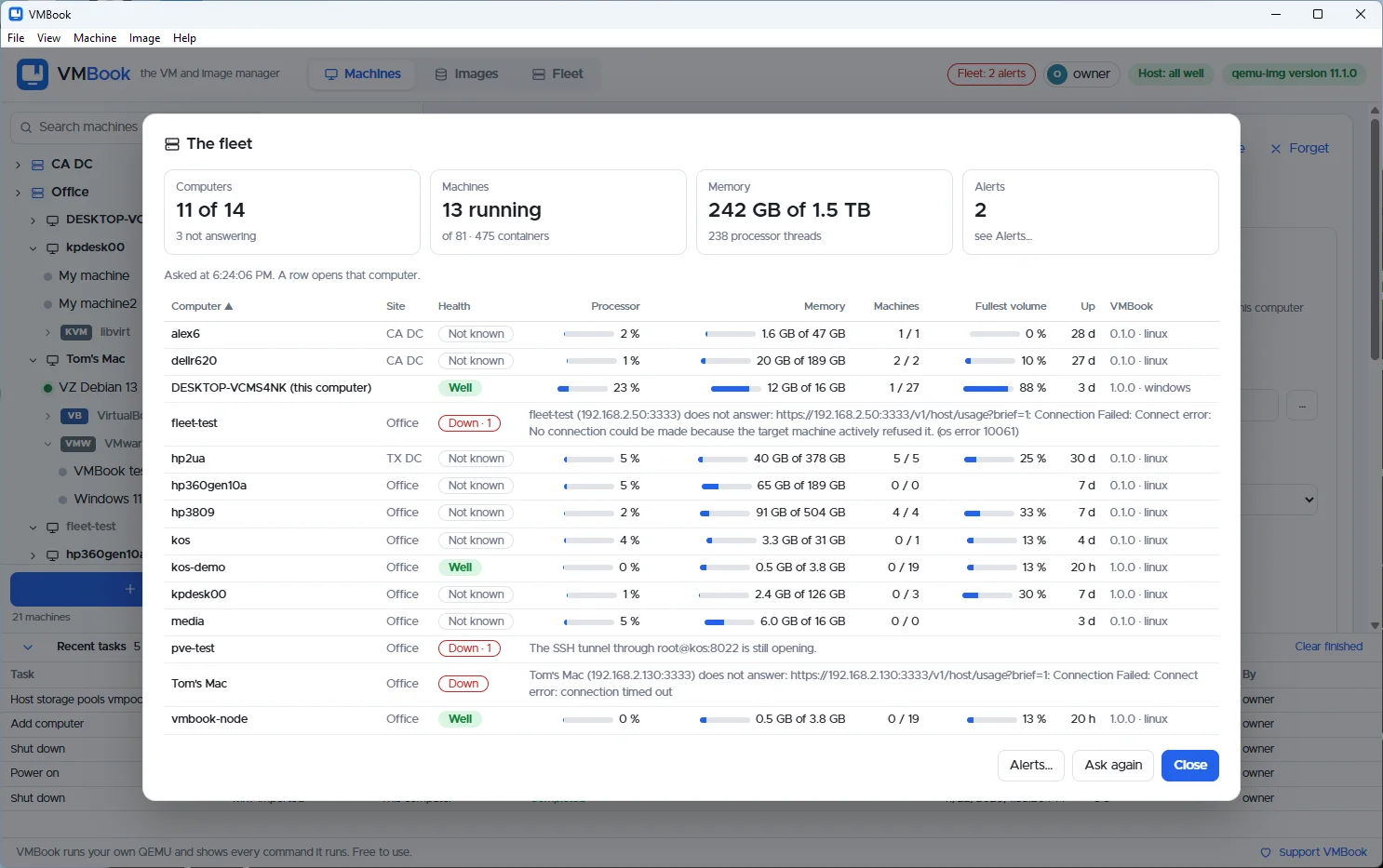
MicroCloud standardizes a few nodes into one clustered stack. VMBook keeps heterogeneous hosts and providers visible without claiming distributed storage or networking.
Choose MicroCloud when
Choose it for a compact Ubuntu-based cluster that needs integrated VM/container, Ceph and OVN capabilities.
Choose VMBook when
Choose it for Windows/Linux/macOS diversity, local desktops, image tooling and CPU architectures beyond the usual server path.
Migration reality
Recreate LXD profiles, storage pools, networks and cluster policy separately from guest disk conversion.
Confirm today’s Mac support
Read current architecture and guest requirements: Canonical MicroCloud.
MicroCloud component and support requirements follow Canonical releases. Verify them in Canonical MicroCloud overview. VMBook is not affiliated with Canonical MicroCloud.
Questions for Mac owners
Questions to answer before moving a working guest: VMBook and Canonical MicroCloud
Is VMBook free compared with Canonical MicroCloud?
VMBook is free. MicroCloud components are open source, while Canonical support and enterprise services have separate commercial terms.
Can VMBook replace Canonical MicroCloud?
VMBook does not replace LXD clustering, MicroCeph replication, MicroOVN networking or MicroCloud bootstrap and lifecycle.
Does VMBook bundle QEMU when compared with Canonical MicroCloud?
VMBook uses QEMU and delegated providers. MicroCloud uses LXD for instances, with MicroCeph and MicroOVN providing clustered data services.
Mac product maturity check
Choose the product that works on the Mac today—not the roadmap that sounds broader.
Compare signed packaging, host integration, guest architecture, graphics, sharing and support on the exact Mac. VMBook’s cross-platform direction does not substitute for published macOS validation.
Review VMBook’s macOS release gate