
A job marked “successful” is an observation about a write operation. Recoverability is a separate claim, earned only when an independent copy creates a working service under the conditions named in the recovery plan.
VM backup software · recovery before retention
VM backup software should prove the machine can return.
Stored bytes are only the first rung. A useful recovery point survives the named failure, reconstructs the virtual machine, boots in isolation and passes an application transaction.
Begin with the failure
The best VM backup software survives your declared loss.
“Best” is not a universal vendor rank. Name what will be unavailable during the test, then require recovery material outside that boundary.
| Failure | Why a snapshot may fail | Backup requirement | Acceptance test |
|---|---|---|---|
| Guest corruption | May preserve an earlier local state | Known-good retained point | Boot a separate copy and validate data |
| Host boot disk loss | Snapshot may live on the same disk | Disks, definition and firmware state elsewhere | Recover with source host unavailable |
| Storage-pool loss | Snapshot and base share the pool | Independent repository and keys | Restore without reading the source pool |
| Ransomware/admin theft | Same identity can delete both | Offline, immutable or separate authority | Prove compromised credentials cannot erase all points |
| Site loss | Local history disappears with site | Recoverable off-site copy and capacity | Exercise network, identity and application recovery elsewhere |
Free VM backup software still has a cost model. Count repository capacity, egress, operator time, monitoring, test compute, retained keys, support and the outage cost of an unproven restore—not only the licence price.

Recovery proof ladder
Six claims separate “we copied blocks” from “the service is back.”
Captured
Required machine state entered the backup workflow.
Durable
Data and metadata survived process and storage interruption.
Independent
The copy survives the declared source failure and authority loss.
Reconstructed
Disks, firmware, controllers and identity form a new VM.
Booted
An isolated guest reaches an observable readiness milestone.
Validated
The application completes a representative read/write transaction.
A checksum validates bytes, not business recovery. A boot screenshot validates a boot, not database consistency. Publish the highest rung actually reached.
Recovery objectives
Make RPO and RTO measurable.
A 15-minute schedule does not prove a 15-minute RPO: the newest point may be incomplete, corrupt or inconsistent. Ten minutes of disk copying does not prove a ten-minute RTO: detection, provisioning, keys, networking, boot, replay and application acceptance all consume time.
How much usable data may be lost?
Measure from the incident to the newest application-validated recovery point.
How long may service be unavailable?
Time detection through accepted service readiness, not only image restore.
Recovery objective worksheet
| Service | Accepted data loss | Accepted outage | Required consistency | Dominant dependency | Test frequency |
|---|---|---|---|---|---|
| Example: finance database | 15 minutes | 2 hours | Database-aware | Logs, identity and DNS | Monthly automated; quarterly owner drill |
| Your service | _____ | _____ | _____ | _____ | _____ |
Consistency is a workload property
Crash-consistent is honest. Application-consistent is earned.
Pause, filesystem freeze and database coordination solve different problems. A multi-disk VM also needs a coordinated boundary; assigning the same snapshot name sequentially is not proof of atomic capture.
Uncoordinated
Blocks are read while writes continue, without an established point-in-time boundary.
Crash-consistent
Equivalent to a sudden power loss; journals may replay and applications may repair.
Filesystem-quiesced
Guest filesystems flush and freeze successfully, but application semantics remain separate.
Application-consistent
Supported writers or workload hooks complete, and recovery is validated by the application.
CBT and dirty bitmaps
Incremental is an efficiency property.
Changed-block tracking can reduce reads after a trusted baseline. QEMU persistent dirty bitmaps and libvirt checkpoints can support that workflow, but bitmap identity, granularity, lifecycle and chain health become part of correctness.
- Bind tracking state to the exact disk and baseline.
- Fall back to full reads when metadata is stale or mismatched.
- Never delete a baseline while dependent points exist.
- Verify manifests, chunk lengths and hashes during restore.
Snapshot versus backup
Rollback and recovery answer different failures.
A snapshot is usually a local point-in-time dependency optimized for short rollback. A backup is independently retained material intended to reconstruct a replacement. A replica may improve availability while synchronizing corruption or encryption.
Decision test: with the source host, pool and administrator credentials unavailable, can the recovery team still create and validate the VM?
Ransomware boundary
“Immutable” must name an authority and a clock.
A repository type alone does not establish resilience. Ask which identity can delete a point, shorten retention, destroy keys or alter the backup policy—and whether the production administrator holds that power.
- Keep offline or independently administered copies.
- Separate production, backup and recovery credentials.
- Use retention enforcement with explicit privileged-bypass rules.
- Protect encryption keys outside the compromised identity plane.
- Alert on policy changes, mass deletion and unusual read volume.
- Restore into a contained clean room before reconnecting.
- Test recovery regularly; inaccessible “safe” copies are not a strategy.
CISA recommends offline, encrypted backups and regular restoration testing because attackers often seek credentials and target accessible backups.
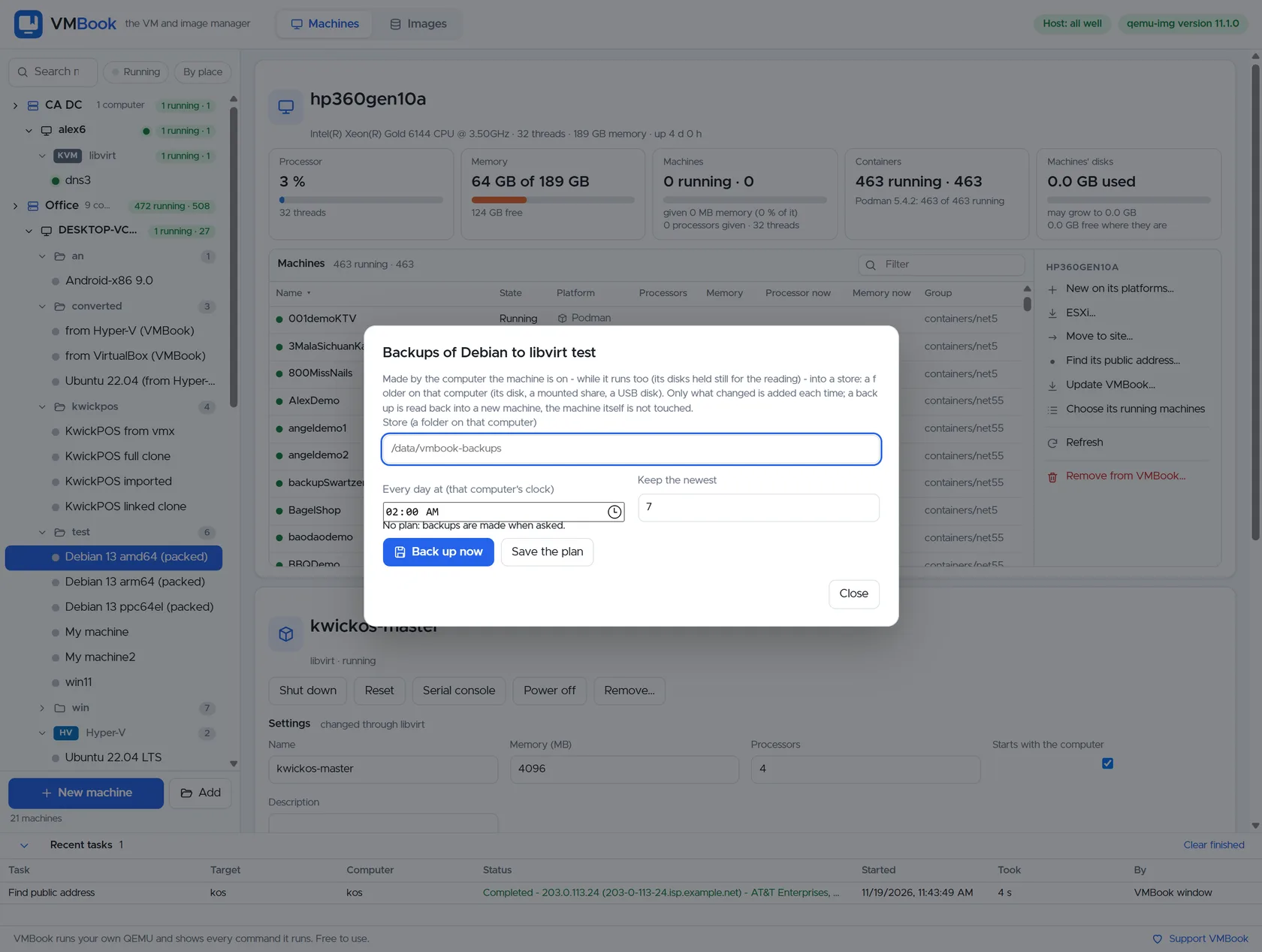
VMBook today · build 1.0.0
Useful backup mechanics, with an explicit evidence boundary.
Source-backed implementation
- A content-addressed store with complete manifests and SHA-256-addressed 4 MiB pieces.
- A running native qcow2 path using a QMP disk boundary and QEMU NBD.
- Persistent dirty bitmaps for later incrementals, with a full-read fallback when state is incomplete, stale or mismatched.
- A running libvirt path that uses an external disk snapshot and requests guest filesystem freeze when available.
- Backup-plan, restore-point, destination, schedule and retention visibility.
Not a current claim
- Universal application-consistent backup or database plug-ins.
- Immutable/WORM repositories, offline media or legal hold.
- Continuous data protection, tape or orchestrated site DR.
- Identical CBT semantics across every provider.
- Automatic application-level restore verification.
- Enterprise backup-vendor support parity.
Engineering acceptance gates: VMBook should not strengthen durability or ransomware claims until concurrent chunk publication is race-safe, completion has a proven durability boundary, restore verifies expected hash and length, sparse regions remain sparse, prune and backup have a lease/generation protocol, and multi-disk/application coordination is evidenced.
Evidence record
Record the restore, not only the backup job.
For every drill retain the source point, manifest and integrity result, isolated destination, reconstructed firmware and devices, boot milestone, application check, actual RPO, actual RTO, operator and corrective action.
A failed drill is valuable evidence when it leads to a tracked repair. A never-tested green status is not.
Six-stage restore drill
Turn a recovery point into operational evidence.
Select
Choose a point without using convenient source history. Record consistency and dependencies.
Contain
Create an isolated network and prevent duplicate identity, mail or scheduled jobs.
Reconstruct
Restore disks plus firmware, controllers, boot order, CPU assumptions and network identity.
Boot
Observe firmware, kernel and guest readiness; retain timestamps and errors.
Validate
Run an application transaction, database checks and dependency tests with the owner.
Dispose and improve
Destroy drill data safely, record measured RPO/RTO and assign remediation.
Thirty-day evaluation
Choose VM backup software with a representative failure pilot.
Inventory and objectives
Select a representative VM; assign RPO, RTO, consistency and failure domains.
Full and incremental
Interrupt jobs, change tracking state and repository access. Inspect safe fallback.
Authority and loss
Remove the source pool; test whether production credentials can erase every point.
Timed owner drill
Restore in isolation, validate the application and compare measured RPO/RTO with targets.
Selection worksheet
Compare recovery evidence, not checkbox count.
| Decision area | Questions to answer in the pilot |
|---|---|
| Coverage | Which hypervisor, disk, firmware, encrypted guest and application versions are explicitly supported? |
| Consistency | What establishes the point-in-time boundary? What evidence distinguishes crash, filesystem and application consistency? |
| CBT | What anchors tracking metadata? What forces a safe full fallback? |
| Independence | Which host, storage, site and identity failures can the copy survive? |
| Immutability | Who can alter retention, delete points or destroy keys, and for how long? |
| Integrity | Are hashes, lengths, manifests and dependency graphs verified during restore? |
| Recovery | Can a clean-room VM be reconstructed automatically and validated at application level? |
| Objectives | Are RPO and RTO measured at accepted service readiness rather than job completion? |
| Operations | Who receives alerts, repairs failed protection and owns restore drills? |
VM backup software FAQ
Short answers, bounded claims.
What is VM backup software?
VM backup software captures the disks and machine information needed to reconstruct a virtual machine after a defined failure. A defensible system also records consistency, retention and integrity, then proves recovery with an isolated restore.
What is the best VM backup software?
There is no universal best product. Choose the product that supports the exact hypervisor and workload, meets accepted RPO and RTO, survives the declared failure domain, and produces a tested application restore.
Is free VM backup software safe for production?
Price does not establish safety. Evaluate support, repository separation, consistency, encryption, retention, monitoring and restore evidence. Free software can be appropriate for a bounded workload when the operator owns and tests those controls.
Is a VM snapshot a backup?
Usually not. A snapshot is commonly dependent on the source platform and storage. A backup should survive loss or compromise of the source failure domain and reconstruct a working replacement.
What is application-consistent backup?
It is a recovery point created with successful workload-aware coordination, such as a database writer or supported guest mechanism, and validated by application recovery. A filesystem freeze alone does not prove every application is consistent.
Does changed-block tracking make a backup independent?
No. CBT or a dirty bitmap reduces the blocks read after a baseline. Its metadata and incremental chain become part of correctness, so fallback, integrity and restore testing still matter.
Are immutable backups ransomware-proof?
No single feature is ransomware-proof. Immutability can prevent alteration during a retention window, but identity, privileged bypass, keys, configuration and clean recovery procedures remain important.
How often should VM restores be tested?
Test in proportion to service risk and after material changes. Critical services need scheduled automated drills plus periodic application-owner exercises; every published RPO or RTO needs recent measured evidence.
Does VMBook provide application-consistent backups?
VMBook can request guest filesystem freeze on a supported libvirt path. Without successful guest and application participation, the result must be treated as crash-consistent. VMBook does not claim universal application plug-ins.
Can VMBook replace an enterprise backup platform?
Not generally in build 1.0.0. VMBook has useful QEMU and provider-aware backup workflows, but does not currently claim immutable repositories, tape, continuous protection, application plug-ins, orchestrated DR or enterprise support parity.
E-E-A-T and scope
Recovery guidance should be reviewable.
Technical owner: Tom Jin
Applies to: VMBook build 1.0.0
Reviewed: 24 November 2026
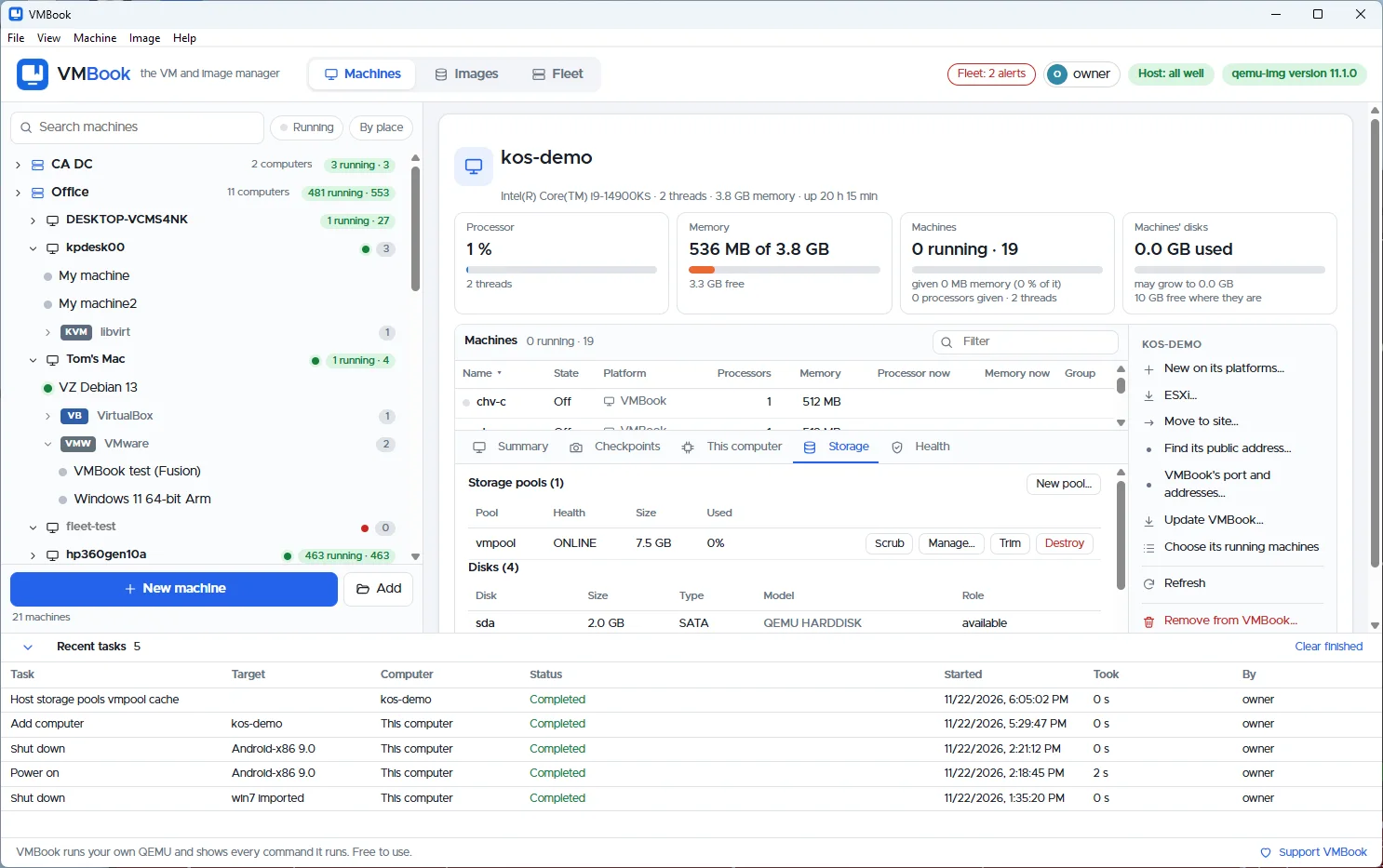
Current behavior is separated from engineering recommendations. Product screenshots prove visible implementation, not durability or certification. Corrections can be reported through VMBook contact.
Primary sources
NIST SP 800-34 Rev. 1 — contingency planning, RPO and RTOCISA StopRansomware Guide — offline backups and restoration testingQEMU persistent dirty bitmapsQEMU live block operationslibvirt domain backup XMLMicrosoft Volume Shadow Copy Service modelVMBook backup strategy and implementation detailVM snapshots explained