

A Mac product choice
Shipping integration versus cross-platform direction: VMBook and Nutanix Cloud Platform.
Choose Nutanix when one supported platform must own compute, distributed storage, networking, availability and private-cloud operations. Choose VMBook when heterogeneous providers, desktop hosts, unusual CPU architectures and transparent QEMU workflows matter more than an integrated HCI data plane.
Use the exact Mac as the test bench
Compare the Mac experience that ships today with VMBook’s current boundary.
| Decision area | VMBook build 1.0.0 | Nutanix Cloud Platform |
|---|---|---|
| Platform scope | Cross-platform VM, image and host management. | Integrated AHV compute, AOS storage, Prism operations and Flow networking. |
| Availability | Migration and diagnosis exist; automatic HA, quorum and fencing are not claimed. | Cluster availability and automated data protection are platform responsibilities. |
| Storage | Local media, ZFS and image workflows; no native distributed storage fabric. | Scale-out software-defined storage is a core platform layer. |
| Best fit | Mixed estates, labs, edge experiments and cross-architecture guests. | Standardized enterprise HCI and private/hybrid cloud. |
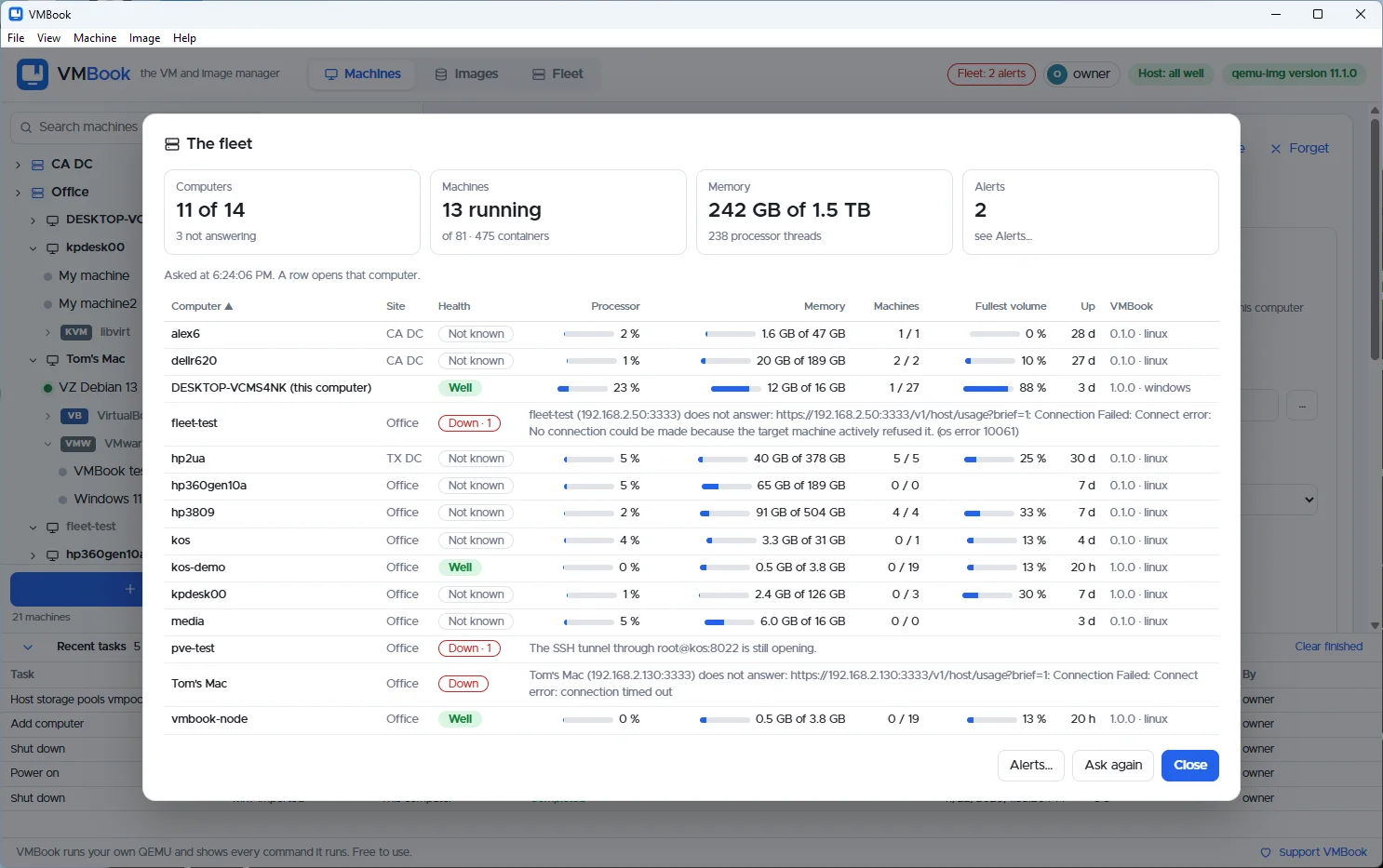
This is a control-plane versus full-platform comparison. A VM inventory screen is not equivalent to distributed storage, quorum, fencing, microsegmentation or tested automatic recovery.
Export deliberately and retain the original bundle
Retain the original Mac bundle and test the export on the exact target hardware.
VMBook does not currently import Nutanix definitions or replace Prism, AOS, Flow, cluster HA, fencing or Nutanix disaster-recovery workflows.
The architectural boundary
Nutanix is an integrated HCI and private-cloud stack. VMBook is currently a management layer across computers and providers; it does not supply a Nutanix-equivalent distributed data plane.
Choose Nutanix when
Use Nutanix when production workloads require vendor-supported cluster lifecycle, distributed storage, automatic availability, microsegmentation and consistent private or hybrid-cloud operations.
Choose VMBook when
Use VMBook for free heterogeneous inventory, QEMU-based multi-architecture labs, disk-image work, desktops and gradual management across providers without standardizing every host on one HCI platform.
Migration reality
A copied virtual disk does not carry AOS protection, Flow policy, Prism categories, availability policy or application recovery evidence. Recreate and test each dependency explicitly.
Confirm today’s Mac support
Read current architecture and guest requirements: Nutanix Cloud Platform.
Nutanix packaging and licensed capabilities vary by edition. Verify AHV, AOS, Flow, Prism and disaster-recovery requirements in Nutanix Cloud Platform. VMBook is not affiliated with Nutanix Cloud Platform.
Questions for Mac owners
Questions to answer before moving a working guest: VMBook and Nutanix Cloud Platform
Is VMBook free compared with Nutanix Cloud Platform?
VMBook is free to use. Nutanix is a commercial enterprise platform with capacity, feature and support packaging that must be quoted for the intended deployment.
Can VMBook replace Nutanix Cloud Platform?
VMBook does not replace Nutanix AOS, AHV cluster HA, Flow networking, Prism operations or the tested hardware and support model. It addresses heterogeneous inventory, QEMU labs and image workflows instead.
Does VMBook bundle QEMU when compared with Nutanix Cloud Platform?
VMBook uses a separately installed QEMU for its own machines. Nutanix AHV is part of the Nutanix platform; sharing KVM ancestry does not make their storage, networking or operations interchangeable.
Mac product maturity check
Choose the product that works on the Mac today—not the roadmap that sounds broader.
Compare signed packaging, host integration, guest architecture, graphics, sharing and support on the exact Mac. VMBook’s cross-platform direction does not substitute for published macOS validation.
Review VMBook’s macOS release gate