

A Mac product choice
Shipping integration versus cross-platform direction: VMBook and OpenStack.
Use OpenStack when the requirement is an API-first multi-tenant IaaS cloud. Use VMBook when a smaller team needs direct, understandable control of mixed computers and providers without operating a distributed cloud service catalog.
Use the exact Mac as the test bench
Compare the Mac experience that ships today with VMBook’s current boundary.
| Decision area | VMBook build 1.0.0 | OpenStack |
|---|---|---|
| Operating model | Host and provider centered. | Service-oriented, API-first IaaS cloud. |
| Tenancy | Scoped VMBook teams and grants; not OpenStack project parity. | Projects, quotas, identity and self-service APIs. |
| Networking/storage | Provider and local-host capabilities remain explicit. | Neutron and Cinder integrate cloud networking and block storage. |
| Complexity | Can start on one computer. | Normally requires a designed, redundant control and data plane. |
Both can reach QEMU/KVM, but the ownership model is different: OpenStack coordinates cloud resources through services and projects; VMBook exposes provider boundaries and individual machines.
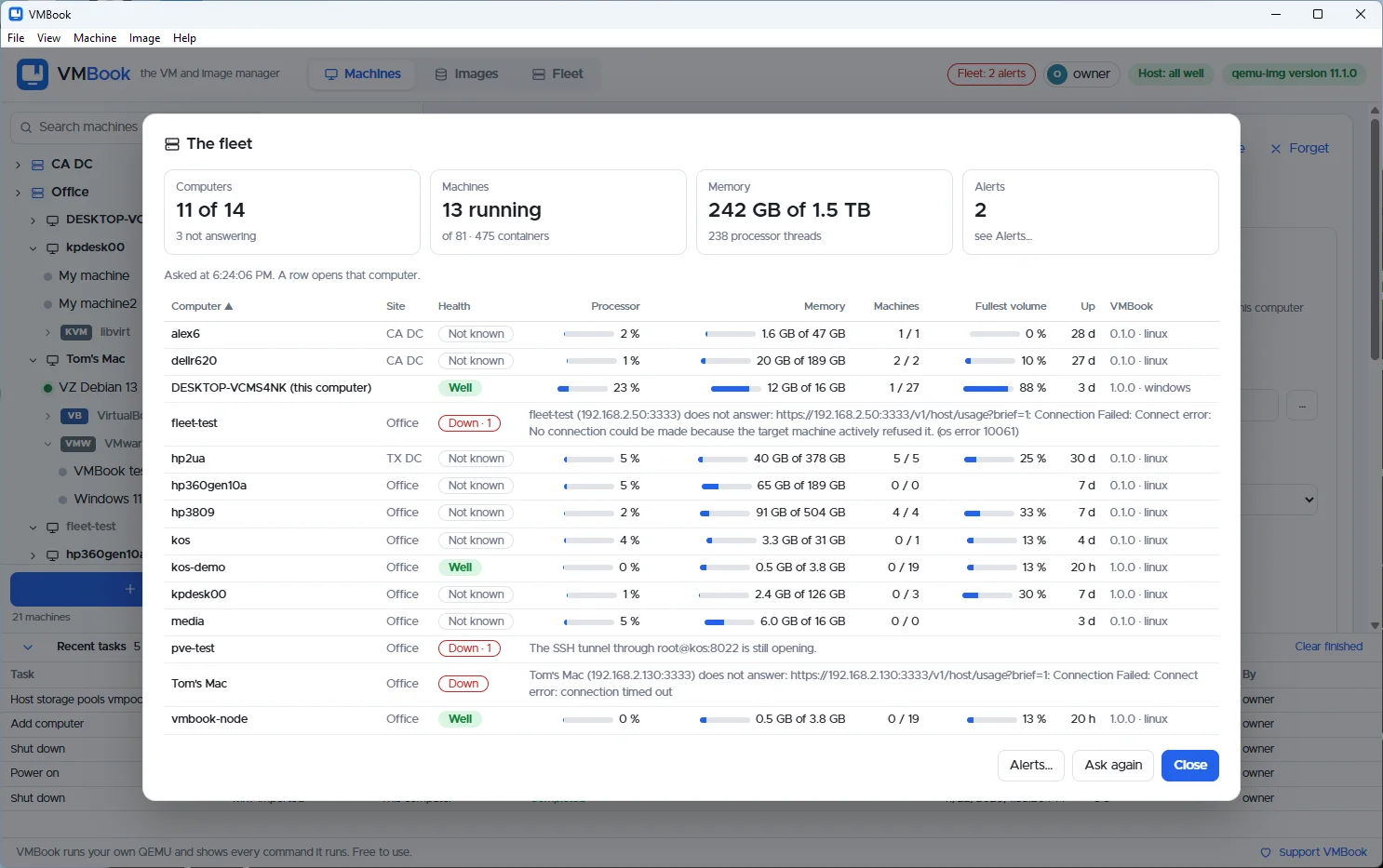
Export deliberately and retain the original bundle
Retain the original Mac bundle and test the export on the exact target hardware.
A disk image can be copied and validated, but projects, flavors, security groups, volumes, networks, metadata and cloud identity require a planned migration.
Cloud service versus machine manager
OpenStack offers tenant APIs for compute, networking, images, identity and storage. VMBook starts from hosts, providers, machines and files rather than a cloud resource abstraction.
Choose OpenStack when
Choose it for self-service IaaS, projects, quotas, cloud APIs, multi-tenancy and large pools operated by a dedicated platform team.
Choose VMBook when
Choose VMBook for a smaller mixed estate, desktop-to-server workflows, image inspection and cross-architecture QEMU work where cloud-service complexity is not justified.
Migration reality
Preserve image format and guest drivers, then separately rebuild flavors, metadata, networks, security groups, volumes, identities and automation.
Confirm today’s Mac support
Read current architecture and guest requirements: OpenStack.
OpenStack capabilities depend on the deployed services, release and distribution. Start with OpenStack software overview. VMBook is not affiliated with OpenStack.
Questions for Mac owners
Questions to answer before moving a working guest: VMBook and OpenStack
Is VMBook free compared with OpenStack?
Both projects can avoid per-VM licensing, but OpenStack carries significant design, integration and operational cost; commercial distributions and support have their own terms.
Can VMBook replace OpenStack?
VMBook does not replace OpenStack multi-tenancy, Keystone identity, Nova scheduling, Neutron networking, Cinder volumes, Glance catalogs or cloud APIs. OpenStack also demands a substantially larger operating model.
Does VMBook bundle QEMU when compared with OpenStack?
VMBook invokes installed QEMU for VMBook-owned machines. OpenStack Nova commonly coordinates libvirt and QEMU/KVM compute nodes, but OpenStack itself is not a hypervisor.
Mac product maturity check
Choose the product that works on the Mac today—not the roadmap that sounds broader.
Compare signed packaging, host integration, guest architecture, graphics, sharing and support on the exact Mac. VMBook’s cross-platform direction does not substitute for published macOS validation.
Review VMBook’s macOS release gate