
Replacing the logo is easy. Reassigning every responsibility is the work.
Nutanix Cloud Platform combines several infrastructure jobs behind one operating experience. A replacement that starts and stops a copied VM but leaves storage protection, fencing, network policy and recovery ownerless is not an alternative.
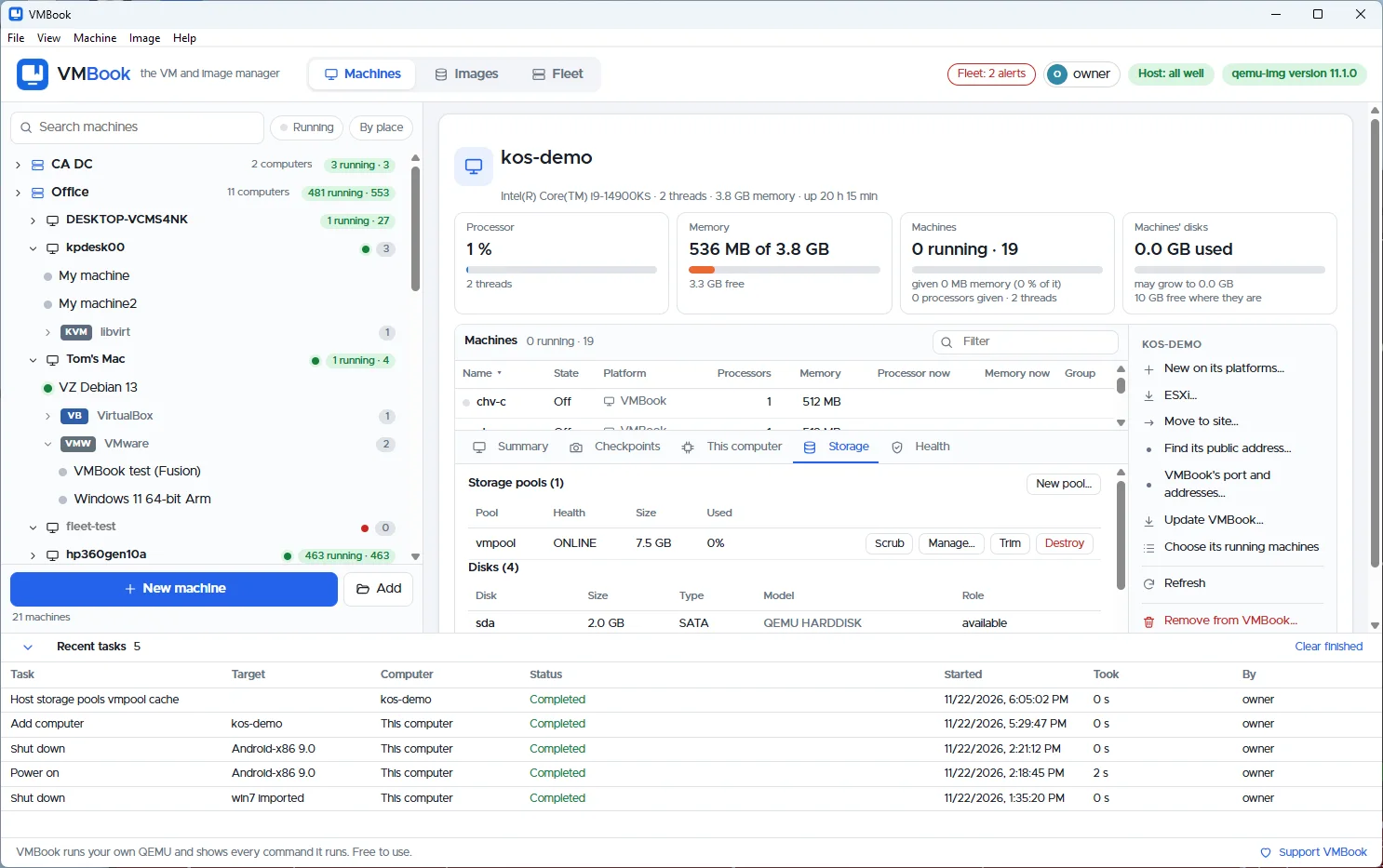
VMBook starts elsewhere: it preserves native provider ownership across heterogeneous computers, manages QEMU machines and images, and can begin on existing Windows or Linux hardware. That is useful during evaluation and mixed-platform operation. It must not be confused with Nutanix-equivalent HCI.

The replacement surface
Ask six smaller questions instead of “What replaces Nutanix?”
For each responsibility, name the current owner, the destination owner and the evidence that proves the new failure behavior.
| Responsibility | Nutanix owner | VMBook today | Required for parity |
|---|---|---|---|
| VM execution | AHV or another supported hypervisor | QEMU/KVM or WHPX machines plus bounded native-provider operations | Tested CPU baselines, devices, admission control and production support |
| Primary storage | AOS distributed storage | Local media, ZFS operations, images and content-addressed backups | Replicated backend, leases, failure domains, rebuild evidence and safe promotion |
| Management | Prism and Nutanix management services | Sites → computers → providers → machines, health, roles, audit and API | HA control plane, long-term metrics, policy reconciliation and rolling upgrades |
| Network security | Flow virtual networking and microsegmentation | Four local private switches, DHCP, NAT or reviewed host bridges | Cross-host overlay, IPAM, security groups, distributed firewall and gateway HA |
| Availability | Cluster HA and placement capabilities | Peer diagnosis, planned QEMU/KVM migration and host drain; no automatic HA | Quorum, fencing, recovery reserve, placement and application verification |
| Data protection | Snapshots, replication, protection policies and DR options by edition | Backup, restore, image and migration workflows | Immutable repositories, application consistency, site runbooks and failback |
Decision rule: “VMBook will show it” is not an ownership answer. Every responsibility held by the current platform needs a destination owner.
Why Nutanix is hard to replace
AHV is visible. AOS changes the failure model underneath it.
Moving an AHV guest toward another QEMU/KVM environment can appear straightforward because the virtualization lineage is familiar. The hard part is preserving the guarantees around its disks.
Nutanix’s current software-options matrix describes redundancy factors, node/block/rack availability domains, snapshots, compression, deduplication, erasure coding, storage QoS and online cluster changes across editions. Those are data-plane behaviors—not fields inside a VM definition.
A stronger VMBook direction is to integrate mature storage backends behind an inspectable contract: replica state, failure domains, leases, rebuild progress, consistency, encryption and tested promotion. It should not attempt a quick imitation of AOS.