
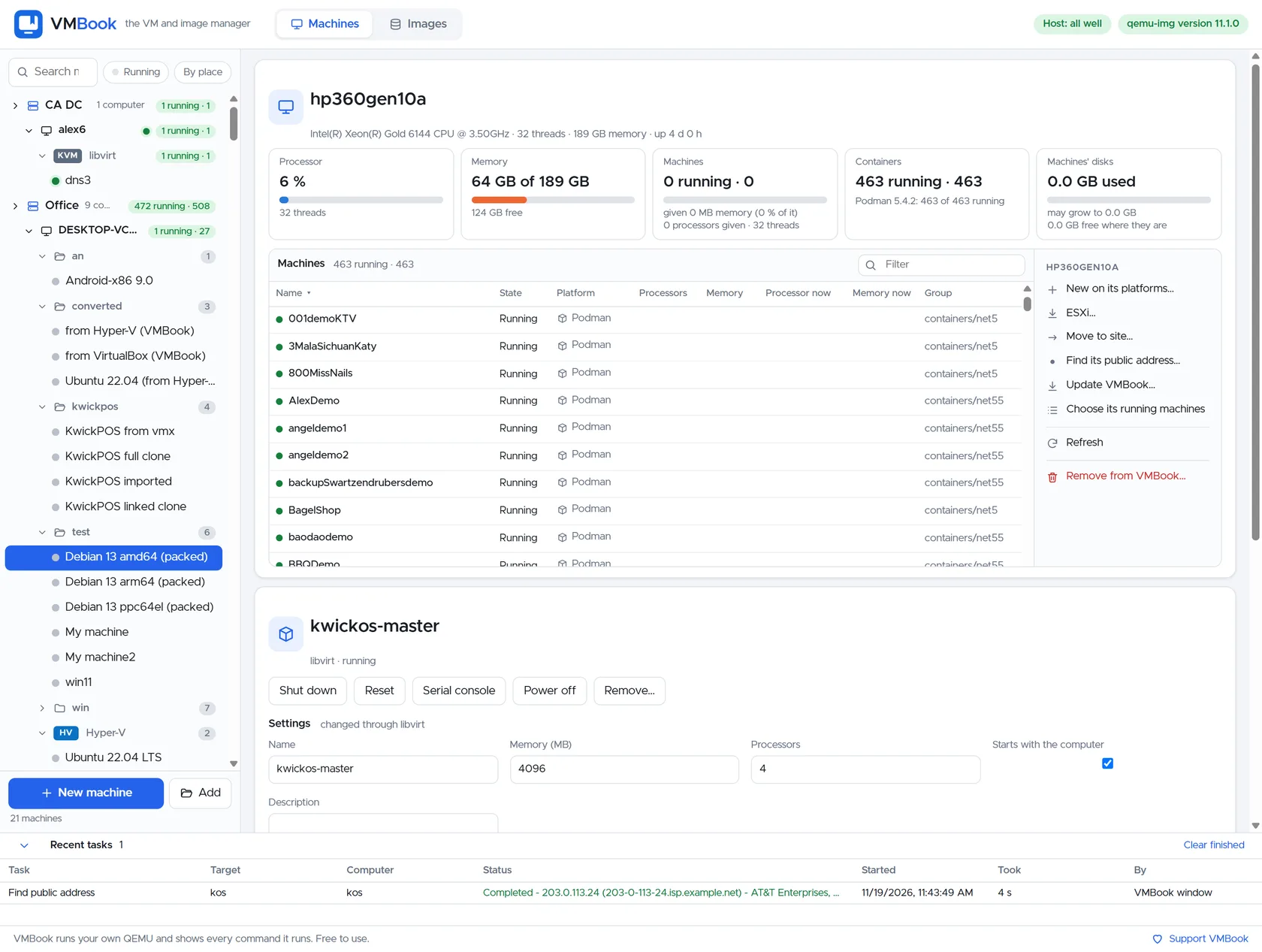
The important distinction
Development evidence is not a release promise.
Every capability below is labelled by what has actually happened. A source path means the operation exists. A laboratory result names the platform on which it was exercised. Neither means the unsigned development build has completed upgrade, rollback, scale, failure-injection and long-duration production testing.
New provider depth
Nutanix and ESXi become operable platforms, not decorative inventory.
Cluster, machine and console operations
VMBook keeps a cluster with a pinned certificate and sealed password; lists machines; starts, shuts down, resets and powers them off; manages snapshots; creates machines and networks; asks Prism to fetch an ISO; uploads a VMBook disk; and carries Prism's VNC console into VMBook's screen.
Storage evidence and reversible tuning
The cluster page reads AOS, hosts and storage-container settings including compression, deduplication, erasure coding and replication factor. Findings explain evidence, proposed change, benefit and risk; an applied change records its previous value for undo.
Create a machine and read its host
The current path creates Linux machines with PVSCSI and VMXNET3, and conservative Windows machines with LSI Logic SAS and e1000e. The provider page reports the ESXi version, host and datastores. It was exercised on the ESXi 9.1 laboratory host.
Keep native ownership visible
Hyper-V, VirtualBox, WSL, libvirt and Proxmox VE now expose their own versions, machines, settings and findings. Examples include Gen 1 machines, checkpoint chains, WSL without a memory limit, stopped pools, full storage and a cluster without quorum.
QEMU build coverage and boot evidence
All 29 system targets are built; nine first-tier architectures have boot records.
VMBook's QEMU 11.1.3 bundle is built for Linux x86-64, Linux Arm64, Windows x86-64 and macOS on Apple silicon. The bundle contains all 29 QEMU system targets. That is broader than the architectures exercised end to end, so the two claims remain separate.
Installing an operating system
Choose a ready system, a network installer or an ISO.
| Path | Current implementation | Observed evidence |
|---|---|---|
| Ready-made image | Checksum-held official cloud image, cloud-init identity and a thin machine disk. | Debian 13 reached login about 35 seconds after the action in the recorded lab run. |
| Network installer | Debian, Alpine, openSUSE, Rocky and netboot.xyz; kernel and initrd cached once on the target computer. | An Alpine installer reduced the first transfer to roughly 21 MB of boot material. |
| Disc image | Attach a selected ISO with architecture-aware machine defaults. | The same flow can create and start a machine on another connected computer. |
| Other processors | Published first-tier images are versioned and held to SHA-256 values carried by VMBook. | RISC-V and POWER kernel/initramfs extraction was checked against real Alpine discs. |
Guarded changes
Configuration changes now explain the consequence before they are kept.
Review
A proposed machine or cluster change shows the old and new value, whether it is well chosen, and what it can do to the installed system.
Refuse
The window and API reject hardware the target computer cannot supply instead of saving a definition that will fail later.
Undo
Tuning keeps the before-state in a journal so supported changes can be reversed deliberately rather than guessed from memory.
Remote screen and reliability work
Input no longer waits behind a stream of pictures.
Each direction of a remote screen now travels in its own thread. In the recorded stress test, mouse traffic measured about 0.44 ms while 1.3 GB of picture data crossed the connection. Fast mode now holds its write lock for the complete frame, preventing dropped frame data, and records transport failures in a dedicated screen log.
Other changes give clones their own Linux machine identity and SSH host keys, add a 32 MB qcow2 L2 cache to Linux image access, prepare libguestfs at service start, record slow image inspection, bound untrusted frame lengths and give legitimately long remote calls up to one minute.
Automated checks
342 passed26 November source snapshotTwo independent suites passed with no failure.
The browser/command suite completed 59 tests. The Rust library suite completed 283 tests with zero failures and two hardware/integration tests intentionally ignored. Passing unit tests support code-level claims; the named Nutanix, ESXi, architecture, update and nightly runs supply separate system evidence.
Still open
What this update does not claim.
- Nutanix AHV refused Pause in the CE 6.8.1 test.
- The Nutanix provider still needs migration from Prism v2 to v4 APIs.
- Nutanix production-cluster scale and failure testing is not complete.
- VMBook does not replace AOS, Flow, HA, quorum, fencing or disaster recovery.
- Cross-provider migration still needs driver, firmware, controller and Windows activation pre-flight.
- A move must verify the destination is truly running before the source can be retired.
- Backup pieces on shared storage still need stronger concurrent-writer protection.
- Remote authorization and password throttling have remaining hardening work.
- Camera requests and parts of the H.264 path still need queue, copy and slow-viewer isolation work.
- ESXi, Proxmox, Hyper-V, VirtualBox, WSL and libvirt tuning is not yet as deep as the Nutanix work.
- The current source snapshot is not a signed public release.
Continue with the exact boundary