
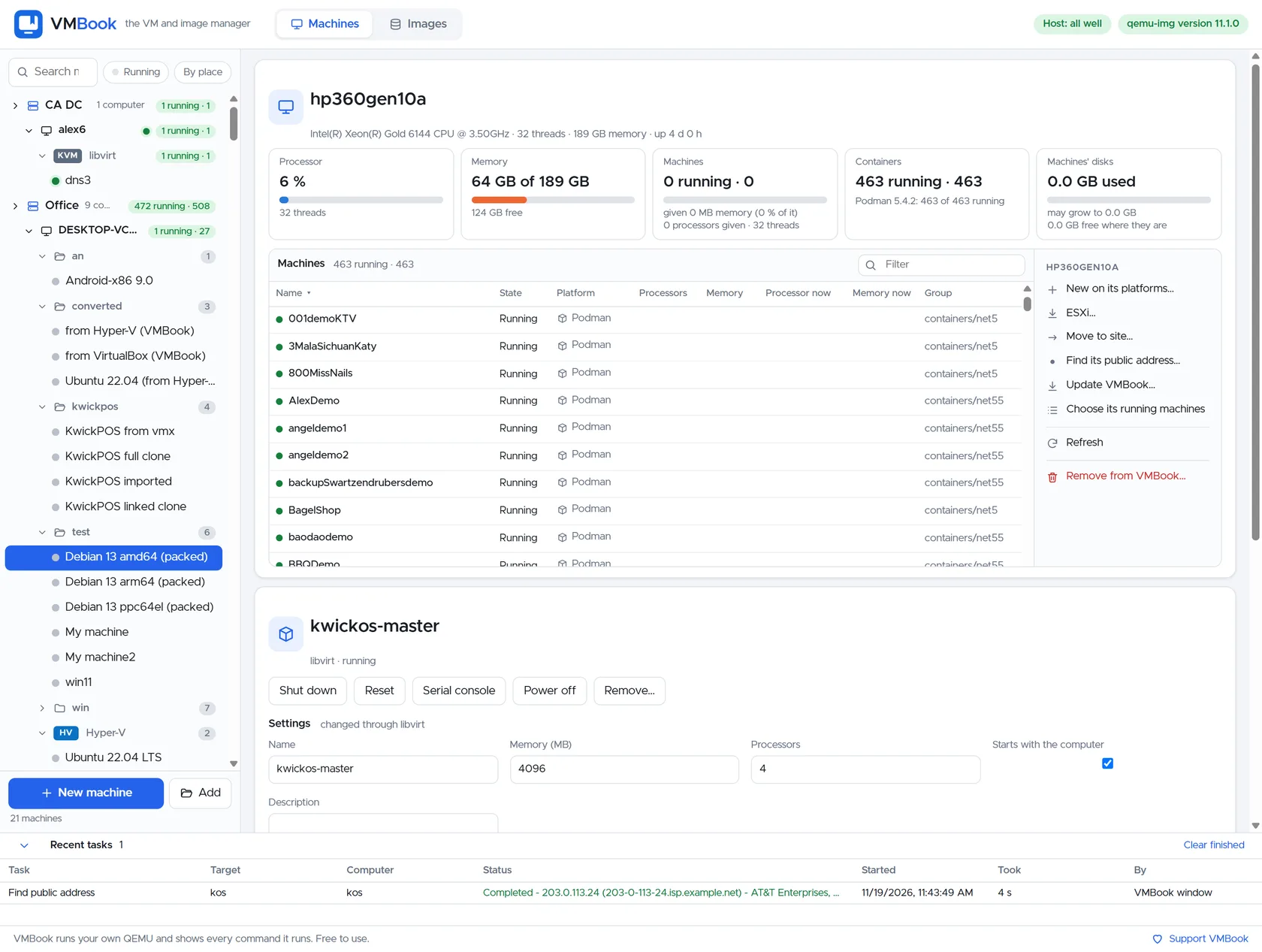
Most replacement projects ask the customer to accept migration risk before receiving value. VMBook can deliver value first: connect the provider, improve daily operations, prove the safety layer and migrate only when a workload has a measured reason to move.
Where established products leave an opening
The problem is not that old hypervisors cannot run a VM.
The problem is the boundary around them: each vendor optimizes its own estate, while operators inherit fragmented tools, costly transitions and changes whose guest consequences are discovered too late.
Adopt the new platform by moving workloads into it.
Connect ESXi, Nutanix, Proxmox, Hyper-V and libvirt first; preserve native ownership.
Validate the field and let the operator understand the consequence.
Guard compares before and after, host capability and likely effect on the installed system.
Show health scores and best-practice findings.
State evidence, expected gain and risk; journal the old value; measure and undo.
Add automation through broad APIs or external agents.
Give MCP agents named identity, narrow scope, approval and audit over defined operations.
Return to separate host, storage, console and recovery tools.
Keep provider, command, console, image, offline files, firmware and recovery context together.
More than a common inventory
A safety and intelligence layer above native providers.
A unified list is easy to imitate. VMBook’s defensible value is the operational layer it adds without pretending every provider behaves the same.
Guard
Explain a proposed hardware or cluster change before saving it; refuse what the destination cannot supply.
Safe changesTuning loop
Observe, explain, approve, apply, measure and undo instead of accumulating permanent warnings.
Reversible tuningGoverned AI
Map MCP tools to employee identity, scope, approval and audit—not an unrestricted remote shell.
MCP and AI agentsRecovery context
Join screen, serial, image inspection, offline repair, backups and provider state around the same machine.
Offline recoveryThe adoption path
Earn trust before asking for cutover.
- ConnectAdd one existing provider with pinned identity.
- ReconcileCompare VMBook state with the native console.
- DelegateEnable only proven, low-risk operations.
- ImproveAdd Guard, health, tuning, approval and AI.
- ProveTest a copied, non-critical workload elsewhere.
- ChooseMigrate only with benefit, acceptance and rollback.
Remove the licence gate
Start on one computer. Grow without buying another VMBook tier.
VMBook is free to use personally, educationally and commercially. Its proprietary licence permits use on any number of computers; optional services are separate.
Open the door before the career ladder
No certificate, cluster or enterprise budget is required to start.
A student can create a first Linux machine and inspect every layer. A hobbyist can turn an existing mini PC into a remote lab. A small company can learn its real backup, access and migration needs before buying a platform. An administrator can practice the same provider boundaries later encountered at work.
Learn transferable concepts
Architecture, firmware, controllers, networks, images, snapshots and recovery remain visible instead of being hidden behind one vendor vocabulary.
Begin with recoverable work
Use copied disks, disposable guests and private networks. Certification is not a substitute for backups, and lack of certification is not a reason to postpone safe practice.
Grow without starting over
The same model can expand from one desktop to a homelab, a small office, remote sites and existing enterprise providers.
Evidence, not adjectives
What supports this direction today.
Nutanix AHV
Prism machines, lifecycle, snapshots, networks, ISO, creation, VNC, storage settings and reversible tuning exercised on CE 6.8.1.
Development evidence; Pause refused; v4 API and production validation open.VMware ESXi
Inventory, retained connection, machine creation and host/datastore context exercised on the ESXi 9.1 laboratory host.
Not vCenter, DRS, HA, vMotion or full datastore parity.Mixed fleet
Sites, computers, native platforms and machines remain distinct; remote services use pinned TLS and controlled operations.
A fleet is not automatic quorum, fencing or failover.Multi-architecture
Development QEMU bundles contain all 29 system targets; nine first-tier profiles have reached login.
Build coverage is not universal guest support.Controlled AI
MCP reads use scoped principals; mutations can become human-approved requests with audit context.
Provider and service-account authority still apply underneath.Engineering checks
The 26 November source snapshot completed 59 browser/command tests and 283 Rust library tests without failure.
Automated tests do not replace production longevity and failure testing.Why the claim stays bounded
Disruption is a direction; production trust must still be earned.
Already distinctive
- Adoption before migration
- Native-provider boundaries
- Guarded changes and undoable tuning
- Scoped MCP and approvals
- Desktop-to-fleet and multi-architecture reach
Still required
- Signed public releases and reliable installers
- External users and long-running production evidence
- More provider depth and failure injection
- Cross-provider migration pre-flight
- New screenshots, cases and independent validation